Blog posts
Insights
Insights
Reclaim What’s Yours: How to Turn Gift Aid into an Automated Revenue Campaign

Joe Geary
October 8, 2026

If you work in fundraising, finance, or database management at a UK charity, you don't need a lecture on what Gift Aid is, or how important it is to UK charities. We all know that 25p in every pound top-up is a vital cornerstone of voluntary income across the sector.
The trouble is that, according to estimates by CAF, £560 million of Gift Aid relief goes unclaimed every year due to complexities for both charities and donors. That’s an eye-watering number that could be going towards medical research, caring for the most vulnerable among us, funding the arts and so much more, but it’s out of reach, partly due to complicated processes.
For charities, often already overstretched and under-resourced, it can easily drift into being treated as a passive, back-office admin chore, managed through periodic HMRC portal log-ins, siloed data, and a flurry of paperwork every quarter, or in some cases, once a year. Database teams struggle with incomplete postcodes, while fundraising managers wonder why campaign returns aren't quite meeting expectations. But it doesn’t have to be this way.
As you plan your high-impact fundraising pushes towards the end of the year, it’s worth taking a fresh look at your database to ensure you’re maximising the impact of every donation you inspire. By reframing Gift Aid recovery from a tedious admin task to an active, automated campaign, you can unlock vital revenue for your cause without asking supporters for another penny.
And it’s often easier than you’d think.
HMRC allows you to back-claim Gift Aid on eligible donations made up to 4 tax years ago.
Every one-off donation, event ticket top-up, or regular gift processed over the last four years where a declaration wasn't captured at the moment of giving is a potential claim sitting in reserve. Collectively, that’s an untapped goldmine hiding in plain sight inside your database.
When fundraising teams look to hit ambitious targets, the default response might be to launch a brand-new appeal, run a social media drive, or design a fresh mailer. All of those require creative budget, staff capacity, and add to donor noise.
A Gift Aid recovery campaign operates on a different logic:
When you treat Gift Aid recovery as a proactive, targeted campaign rather than a reactive tick-box, the return on effort is hard to beat.
Thousands of pounds lie dormant across UK charity databases simply because historical transactions aren't linked to a valid, active declaration. In legacy CRMs, finding these missing links means manual cross-referencing: matching CSV export files against scanned paper forms or disjointed web logs. It’s tedious, prone to human error, and usually ends up at the bottom of a busy team's ever-growing to-do list.
Modern CRMs help by bringing clever logic into your database. Instead of forcing you to run manual exports, historical payment records are scanned in real time. They flag eligible gifts from UK taxpayers that lack linked declarations across the past four years, giving you a live dashboard of potential payments ready to be claimed.
Oracle Head and Neck Cancer UK: After switching to Beacon and setting up automated tracking, Oracle Head and Neck Cancer UK uncovered ~£20,000 in unclaimed Gift Aid that had been left behind by old manual processes.
Kids Matter: Historical tracking was so complex under their previous setup that thousands of pounds had been left on the table. When they moved to Beacon, they uncovered over £12,000 in backdated Gift Aid - effectively paying for their entire CRM subscription right out of the gate.
We’re all used to quick, seamless digital interactions, and your declaration process needs to feel just as straightforward. If claiming back-dated Gift Aid requires printing off a PDF, signing it, and posting it back, most supporters simply won't get round to it.
With modern CRMs, gathering declarations becomes a smooth background workflow:
If your finance or admin team currently spends days reformatting spreadsheets, fixing column headers, and fighting with HMRC portal timeouts, you’re not alone. But there is a far less stressful way to handle it.
Modern CRMs like Beacon integrate directly with HMRC. Your eligible gifts are aggregated throughout the month, any potential errors are flagged beforehand, and a single click will push the claim straight to HMRC.
No gateway timeouts, no file reformatting, and full automated audit trails built in. Once HMRC pays out, Beacon simplifies payout reconciliation in your finance tools like Xero.
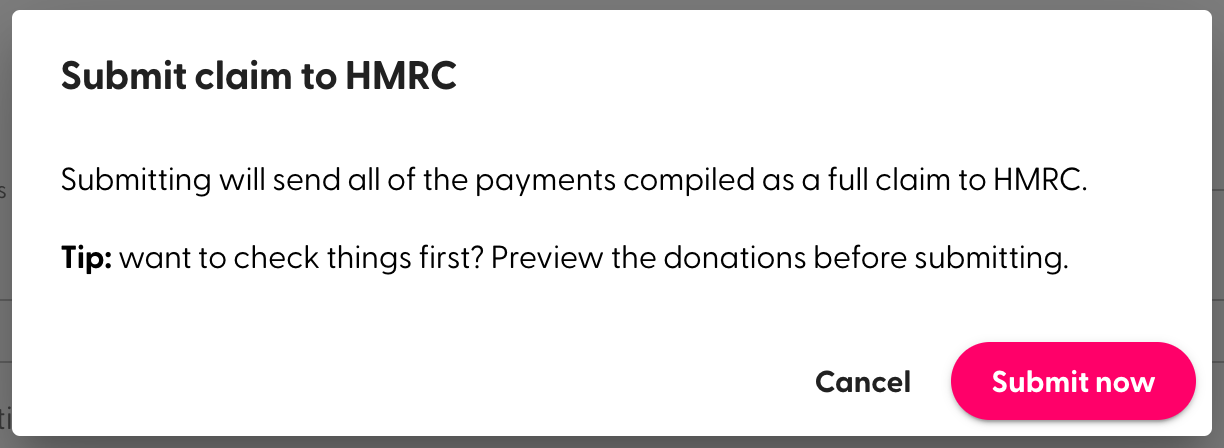
I don't like doing Gift Aid... but now, once a month, I push a button, and the claim is sent. A few days later, HMRC sends the payment. It's just changed my life. – Sue Karney, Phab
HMRC’s submission systems are notoriously strict. A single missing house number, a typo in a postcode, or a full name crammed into a single field can trigger a rejection for an entire batch, delaying payouts for weeks.
Modern CRMs can help keep your database clean by default, avoiding submission mishaps:
Gift Aid doesn’t have to be an admin headache that consumes days of your team's precious time. With the right technology in place, it becomes a reliable, automated revenue stream that powers your cause year after year.
Over 1,500 charities use Beacon to make their Gift Aid claim submissions a one-click job, once a month. If you’d like to see how your organisation could do the same, get in touch. We’d love to hear from you.

.png)